Tuesday, October 16, 2012

R.H.Quaytman

Many aspects of R.H.Quaytman's work relate to the complexity of perception. The imagery within her paintings rage between figurative, architectural, and abstract visual stimulation (i.e. very close radiating lines which appear to vibrate). To me, the most successful aspect of her work is her ability to create depth while also being confronted by the flatness of a line. 

There is also a macro vs micro feel to her work with the way she titles them. For example, her works a the Whitney Museum in 2010 were all a part of Distracting Distance, Chapter 16. By titling all her works by chapters, there is the perception that you're seeing a segment of a larger narrative. Many chapters relate to the location that they are shown in.

The first image, A Woman in the Sun-With Edges, was shown in the Whitney, and the image was photographed in the museum clearly before the making of the work. The Marcel Breuer window displayed prominently in the painting, is located in the museum and even the tittle references a paining and the pose of the nude figure reference an Edward Hopper painting associated with the museum. There is an experienced lost by seeing these works out of their context. I imagine that Quaytman wanted the viewer to realize the flatness of the representation within the painting as they stand in the room being depicted.


Monday, October 15, 2012

Corinne Wasmuht


Ezeiza 2003
       Corinne Wasmuht was born in 1964 in Dortmund, Germany and currently lives in Berlin. She is a contemporary artist that has been creating work since the 90s and continues to create work today. As such, she faces issues like globalization, economic crisis, proliferation of technology, modern warfare- all of the concerns that we feel today about the changing world can be considered influential on her life and work. Her current work is centered on creating an atmosphere that underlines that feeling of “information overload” resulting from today’s profusion of mass technology and media. Wasmuht’s paintings of overlapping images confuse orientation and clarity, and the sheer scale of them allows the audience to become completely enveloped by the realm that she has created. The non-hierarchical composition becomes fragmentary, as if one is constantly receiving bits of information and collaging them together in a jumbled incoherent mix.


Pathfinder 2002
       The content of her work is seemingly at odds with her method of painting: a painstaking application of luminous glazes to create multiple layers that visibly illuminate the paneled wood on which she works. However, this method allows Wasmuht to create an ambiance of “electronic” light with images that seem to be illuminated from behind as if they were being projected, similar to the way a television or computer screen appears. This method also permits the viewer to see how slowly and deliberately she has worked on each image, making detailed and acute decisions that affect each image and the entire painting. I see this process as being one of her greatest strengths and her most successful artistic practice, because it allows her to communicate with the audience the intentionality behind her painting and create a sort of “alternative world” of technology and information that one can get lost in. I believe Wasmuht’s least successful method of working comes from her practice of limiting the images in her composition to being only those of which she has photographed herself and digitally transmitted. In this way, her hand is there at the beginning, and she limits her ability to allow for a moment of zero manipulation where it is only about gathering the images as they are, already transmitted in their own unique way.


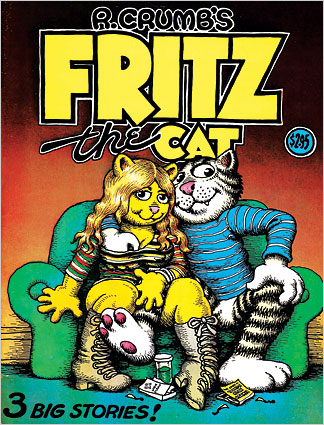
Robert Crumb was born in 1943. His father was in the U.S. Marine Corps and his mother had manic depression. He also had an older brother Charles who loved comics and became one of his biggest influences during his childhood. At first job for the American Gretings Corporation, his grotesque drawing style developed a sense of cuteness leading to his people looking like large footed pin-headed youths. Then in 1965 he started taking L.S.D. which changed the way he thought about and drew comics. During this time period he created many of his future characters including Mr. Natural, Mr. Snold, Fritz the Cat, and Angelfood McSpade. Soon after he began producing underground comics which is what he was mainly known for.
Crumbs work’s strengths are in it’s eye catching seductive imagery and easily recognized style. It intrigues the more grungy and naughty interests of the viewers that make them stop and read his work. His subject matter is also a huge strength of his work because it comments on all aspects and issues of American social life and politics during the late 1900s.  While all tiers of social America are his subjects, it's their personalities and interactions that he is really interested in. Crumb’s work is all about meaning. ALl of his work critiques the human life and societal values during the time when they are controversial. His work entitled “Whiteman” made in 1967 about a typical uptight, white American during the Nixon era who encounters a group of african americans on a way to a parade. During the course of his brief interactions with the group he is critiquing the social politics of whites and blacks as Whiteman breaks down through this confrontation.

 His characters and the social settings they are in are the vehicles he uses to convey meaning. He makes his characters look out of proportion and almost ugly with side of humor. Their feet and hands are big and the women's bodies are exaggerated. However, while he had done a lot of underground comic work, he now works on some more main stream art. Recently, he finished illustrating the whole book of Genesis. Although his drawings are perhaps more mainstream in appearance, there is still an element of crudeness in his humor and imagery.


Sunday, October 14, 2012

Honoré Daumier: Master of Subtlety


HonorĂ©  Daumier was a French lithographer famous for his masterfully rendered satirical illustrations. At the time Daumier was working (mid to late 1800s), France was undergoing major societal changes. In 1830, Charles X had been overthrown in The July Revolution, and Louis Phillipe I took his place. During Charles X's reign, French artists and intellectuals had been at the forefront of an opposition movement against the king. Daumier was deeply frustrated with the corruption of the French government, and he contributed a number of illustrations to his friend Charles Phillipon's satirical publications, Le Caricature and Le Charivari. In 1832, he was jailed for six months for publishing Gargantua, which depicted the new king, Louis Phillipe, as a monstrous giant who devours his subjects (see below).


In general, Daumier is known for critiquing the excesses, corruption and hypocrisy in French bourgeoise society. In one of his famous series of prints, Daumier chronicled the exploits of Robert Macaire, a mythical villain in mid-nineteenth century French popular culture. The illustrations were, in the words of Daumier's publisher, an attempt to mock the "Robert Macaires" of French society. The prints appeared in La Caricature and of Le Charivari (below are two images from the series):


Not all of Daumier's images were satirical. One of his most famous prints is Rue Transnonain, a lithograph that depicts a man brutally massacred by government troops during a riot in 1834 a working class neighborhood of Paris. To me, the image represents many strengths of Daumier's work: attention to composition (strong diagonals), dramatic lighting and subtle tonal rendering. What's so haunting about the image is its grace, despite the fact that it depicts a gruesome subject. A close inspection of the print reveals that the man in the center of the image is not sleeping (as it might appear at first glance), but dead: he is surrounded by pools of blood. Crushed underneath him is a dead child, whose small hands and face have been delicately rendered by the artist.


I would consider Rue Transnonain to be one of Daumier's most successful pieces — but this is not to discount Daumier's satirical prints. The gestural line quality of all of Daumier's drawings give them a freshness today, when the issues the artist was concerned might seem irrelevant. Daumier's images are subtly drawn, so that every character— however absurd— feels believable and animated. In his more somber work, like Rue Transnonain, the figures are drawn with empathy and care, which allows viewers to linger on the details of the man's face, or the baby's hands, and mourn the injustice of their murder.

When I look at Daumier's work, I am blown away by his technical gifts and his ability to convey so many emotions and subtleties through drawing. I am also impressed by his prolific career— during his life, he produced 4000 lithographs, 1000 wood engravings, 1000 drawings, 100 sculptures and 500 paintings. WOW! No one can say he sold out—he's a far cry from Thomas Kinkaid.


Rashid Johnson: Infinite Blackness


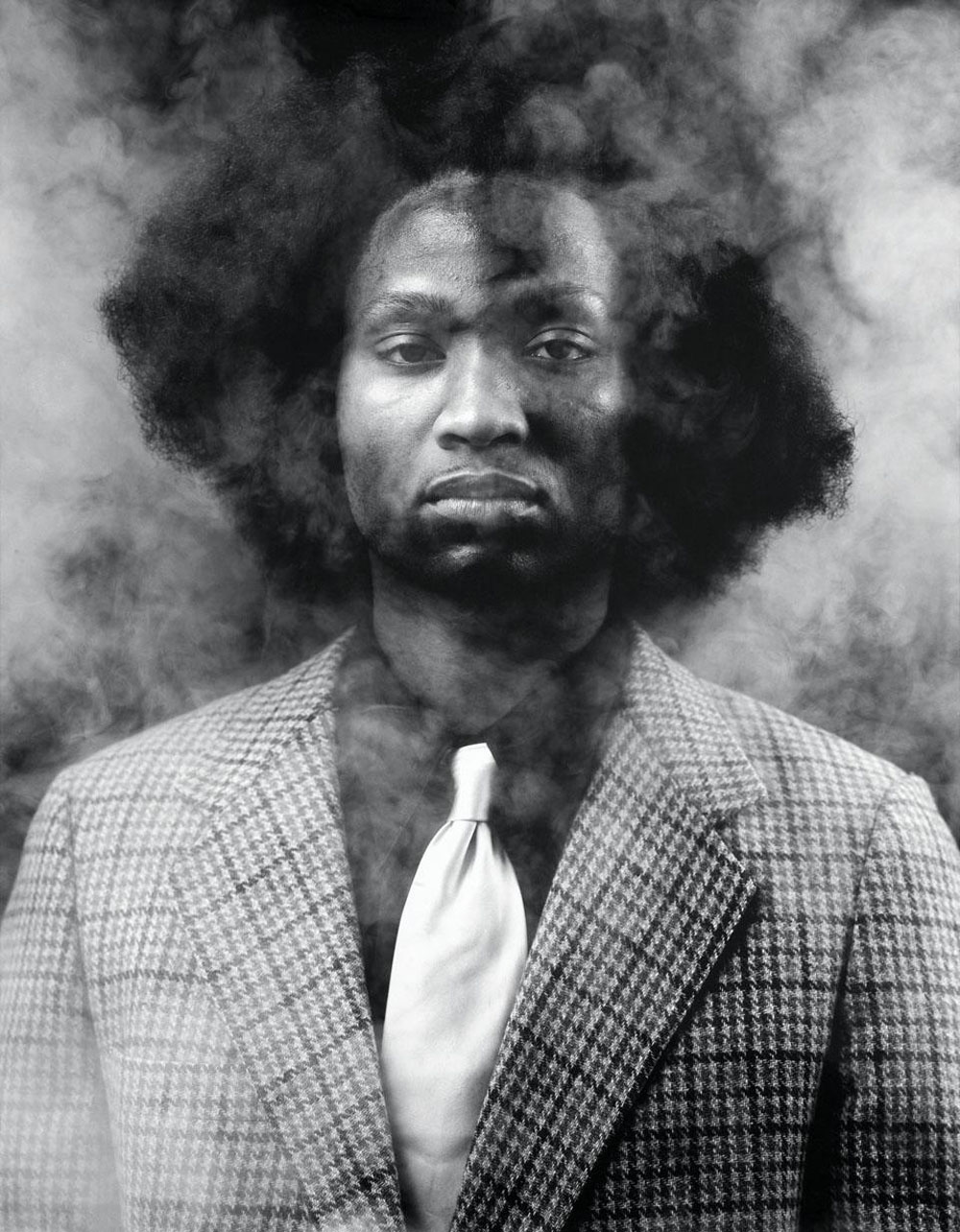
Obsessed with what Tom Morton defines as "African intellectual history," artist Rashid Johnson has developed a visual and conceptual hierarchy to create what some critics refer to as afrocentric art-historical artifacts and textual readings.
Demonstrating a great fascination and embrace of African-American culture from throughout history, Johnson creates works that display interweaving references, drawing connections and hierarchies between important African-American figures, events, texts and other historically-significant materials. Such artifactual relationships establish a rich and systematic collection of memories and snapshots that reflects a complex and vivid language for discussing this African intellectual history. In his installation work, Rashid Johnson demonstrates an obsessive craft of intimate detail, creating complex pieces with many small objects and other subtle visual imagery that all pay homage to something from the afrocentric past. By making these historical connections, Johnson draws conclusions on the single story of the African-American experience through the last few centuries and how it has encountered many recurring triumphs and struggles.

Originally focused on portrait photography, Rashid Johnson has always sought to tell the story of the African-American. Since breaking into installation art and experimenting with new materials such as black wax soap and shea butter (which both reference African culture), his work has become ever-more complex. With such intricate pieces it is important to note how conceptual accessibility plays a role in the power of the art. Beginning with his photographed portraits, Johnson has had a keen eye on emphasizing the distinct loss in translation for African-American culture to his caucasian audience (which racially dominates the art world today). With the installation pieces Johnson brings out a rich and detailed story that his audience cannot fully comprehend, an experience that strengthens his concept yet inhibits his audience from fully engaging with the work.

Such a presentational dilemma is clear in the piece How Ya Like Me Now (2010, Persian rug, gold embroidery and shea butter). Unless the viewer can recognize that the design stitched into the rug is the logo of hip-hop group Public Enemy, and that many of the group's performers are also members of the Nation of Islam movement, the connection between the pop culture icon and religious motif would not come across as fluid as Johnson had hoped.


Despite this break in the chain of dialogue between artist and audience, the art demonstrates a unique testament to everything historically African-American. For Johnson's work to be successful and penetrating, his audience must have the same obsessive knowledge of African intellectual history as that of the artist, because once a viewer can identify each reference and historical nod, he can then lay out the pieces and solve the puzzle that Johnson lays out in his "Post-Black" art. With this in mind we must ask whether it is the audience that isn't getting the message across, rather than placing the blame on the artist.